

Decide what helpful support looks like before you arrive
A companion can reduce the pressure of remembering every option, but only if both of you know who makes the final call. Take two minutes beforehand to agree on the purpose of the visit: exploring coverage, matching a familiar look, or learning what would feel comfortable day to day.
Give the support person a clear, limited role
Ask your companion to observe rather than persuade. They can write down the style name, notice whether the front sits evenly, and say which option looks most like the effect you asked for. They should also feel free to say when they are unsure. That protects your decision from becoming a vote on what another person would wear.
This approach is especially useful when hair loss is connected with treatment. Cancer Research UK’s wig guidance notes that many people find a relative or good friend helpful at a fitting, and that a private room can be requested. Start from what makes you comfortable, whether you are considering chemotherapy wigs or another appearance-focused option.
- State one priority for the visit, such as a natural everyday silhouette or an easy-to-manage option.
- Tell your companion whether you want direct opinions, quiet note-taking, or both.
- Agree that you can pause or leave without selecting anything that day.
Bring reference material that makes comparison easier
The most useful preparation is small and specific. A support person can keep your images and notes together, so you can look at a sample, then return to the same reference without relying on memory or a phone camera under mixed indoor light.
Choose photos that show your normal styling habits
Bring one recent front-facing photo and one side or three-quarter photo in daylight if possible. Choose pictures that show your usual parting, length and amount of volume, not a heavily filtered image. The American Cancer Society suggests taking photographs of your current style before hair loss if you hope to match it, and comparing colour swatches in natural light near a window or outdoors. Read its wig planning advice.
Also record situations rather than only a colour name: air-conditioned office days, humid commutes, glasses, headwear, or the amount of time you expect to wear it. If your preference is a made-to-measure discussion rather than a ready-made comparison, write down which details you want clarified for a bespoke human hair wig. A reference photo describes a direction; it does not prove that a particular construction, shade, or styling result will be suitable.
| Bring or note | Why it helps | What the support person can record |
|---|---|---|
| Two unfiltered reference photos | They show your normal parting and overall proportion | Which viewed option best matches the intended outline |
| A short daily-routine note | Comfort needs depend on real wearing situations | Where pressure, warmth or movement is noticed |
| Three priority questions | They prevent important issues being lost in conversation | The answer and any point that needs confirmation |
| Glasses or usual accessories | They reveal contact points around the ears and face | Whether the fit remains comfortable with them |
| A phone note with option labels | It keeps later comparison factual | Style, colour, construction and next step for each option |
Check fit before deciding whether a style looks right
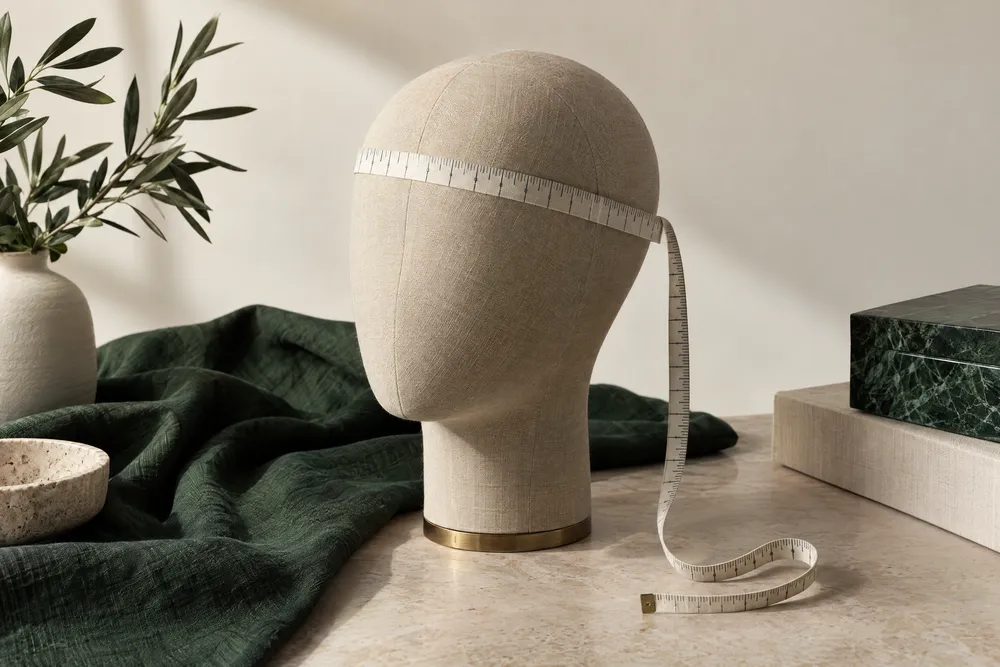
A flattering colour or cut can distract from a poor fit. Let the support person view the front, both sides and back while you move normally. Their notes should distinguish what was actually observed from what still needs to be checked on a different option or at a later fitting.
Use calm movements and ordinary viewing distances
First sit upright, turn your head, look down to read a phone, then stand and walk a few steps if the setting allows. Ask whether the front looks level, whether ear areas feel crowded with glasses, and whether the cap shifts. Do not force a quick decision from a mirror-only view. Dana-Farber Cancer Institute advises that the foundation should feel like a second scalp, not uncomfortably hot or heavy, and that staff can help when securing a wig is difficult. See its choosing-a-wig guidance.
Write ‘felt fine for five minutes’ separately from ‘comfortable for my normal day’; they are not the same conclusion. If you are deciding between a partial coverage piece and a full option, ask exactly where it is meant to sit and what must be confirmed in person. The custom hair topper Hong Kong information can help frame a coverage-focused enquiry, but only an actual discussion can establish the fit for an individual head and chosen piece.
- View the front hairline from conversational distance, not only close up in a mirror.
- Try ordinary head turns, looking down and wearing glasses before calling a fit secure.
- Record the location of any tightness or movement instead of labelling the whole option good or bad.
Compare visible details without chasing a perfect replica
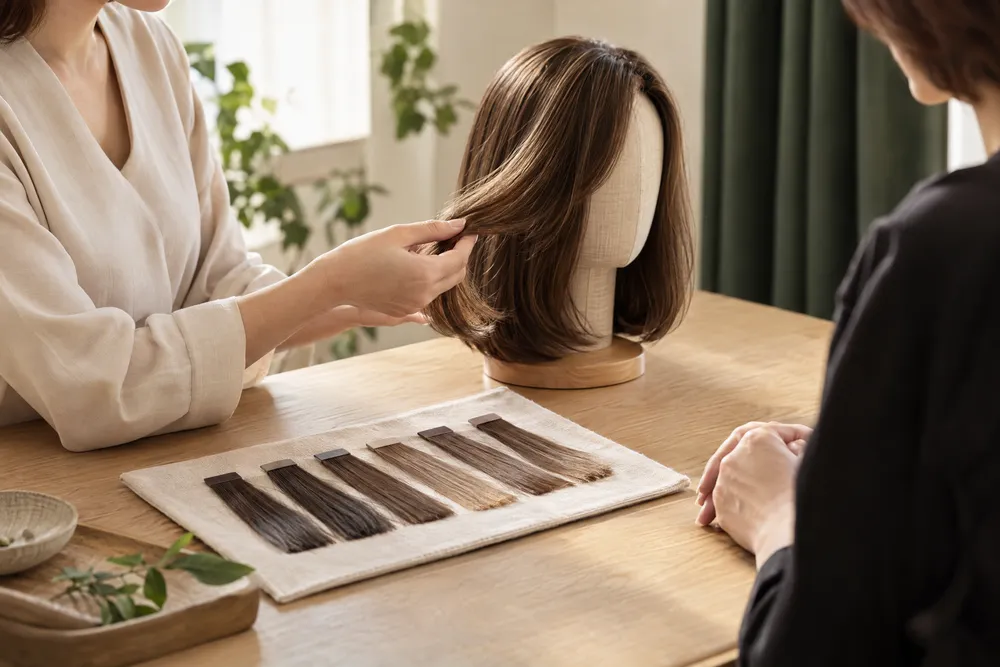
The goal of a first appointment is a useful comparison, not a promise that every strand or angle will reproduce a reference image. Work from the features people notice first: overall outline, parting, front edge, colour depth and the way the style relates to your face when you move.
Ask the support person to name what they see, not what they assume
Use neutral language such as ‘the fringe sits lower on the left’ or ‘this shade appears warmer by the window’. It is more helpful than ‘that looks fake’ because it points to a detail that can be shown again. If texture, colour family or styling expectations are central to your decision, the comparison notes can sit alongside the questions in Asian wigs, where colour, length and cap fit can be considered as separate visible factors.
Try no more than a manageable number of options before you review notes. The support person can make a two-column record: what you liked and what requires an answer. If you are choosing a full-coverage style, note whether the silhouette feels like you rather than asking whether it is the most dramatic change. The women's wigs collection is a useful destination for continuing a full-head coverage comparison, not a substitute for trying an individual option.
Turn the fitting notes into questions with clear answers
A first appointment is productive when it ends with questions you can repeat accurately. Your support person can read the notes back before you leave. This catches vague decisions such as ‘I think it will be fine’ and turns them into a next step that a service team can answer.
Separate construction, security and care questions
For each promising option, ask: what part of the observed look depends on the construction; what adjustment is available; and what care instructions come with that particular item? If the conversation turns to tape or other attachment aids, do not assume they are required. A well-fitting wig may stay in place without extra aids, while the product, skin condition and removal method all need individual confirmation. Record a precise question for Walker Tape wig adhesive rather than treating an adhesive name as a universal solution.
For someone comparing a men’s hair system, the notes should say whether easy removal, continuous wear, visible edge management, or everyday routine is the concern. Those are different choices, which is why removable vs bonded hair system for men is best read as a decision framework. Ask what the relevant method involves for the selected system instead of transferring a routine from one type of product to another.
- What did I observe about the fit, and what still needs a real-world check?
- Which construction or styling point is responsible for the look I prefer?
- What care, attachment or removal detail must be confirmed for this exact option?
Make room for changing needs and personal boundaries
A support person can help you remember that hair concerns are not identical from one person to another. You may be choosing coverage after treatment, exploring a change in density, or simply trying a new appearance. The conversation should remain at the level of styling, comfort and practical choices unless a healthcare professional needs to advise on health concerns.
Name the kind of coverage you want to discuss
If patchy loss or ongoing change is part of the context, describe the area you want to cover and how you want it to look in daily life. Do not expect a companion’s opinion to explain the cause of hair loss. The alopecia wigs guide can help you organise cosmetic coverage questions, while questions about symptoms, treatment or scalp health should go to an appropriately qualified healthcare professional.
Give yourself permission to say that you are not ready to decide. Macmillan Cancer Support explains that there is no pressure to choose a wig immediately and that fitting can be emotional; it also notes that a well-fitting wig should stay in place on its own. Read Macmillan’s guidance on wigs for cancer treatment. Your support person can protect that pause by asking for a written label or photo record of the options you want to revisit.

Leave with a compact checklist for the next enquiry
Before leaving, reduce the discussion to a small record that makes sense tomorrow. The companion can read it aloud and the wearer can correct anything that does not feel true. This protects you from making a decision based only on a favourite photograph taken during the appointment.
Use a final three-part review
First, write the option or direction you preferred and the visible reason: outline, parting, colour or coverage. Second, write one comfort observation and one movement observation. Third, write the unanswered question that affects your decision most. A useful note might say: ‘Preferred the softer front outline; felt pressure above the right ear with glasses; ask whether another size or adjustment changes that.’ It is an observation, not a diagnosis or a guarantee.
If you want to continue the conversation, send this short record with the reference photos and ask for the relevant options to be explained. The aim is not to force a yes-or-no answer from a single meeting. It is to make the next enquiry calmer, more specific and easier for both you and your support person to follow.
- Preferred option or direction, plus one visible reason.
- One comfort observation and one movement observation.
- The single question that must be answered before you decide.
| Moment | Wearer checks | Support person records |
|---|---|---|
| First mirror view | Whether the overall look feels like the intended direction | Front alignment, parting and side-to-side balance |
| With glasses or accessories | Pressure at ears, temples and behind the neck | Whether the visible edge sits naturally around accessories |
| Natural movement | Any slipping, pinching or heat concern | What changes when you turn, look down or walk |
| Different light | Which colour effect you prefer | Whether shade or density appears noticeably different |
| Before leaving | Your unanswered question | Option label, notes and a factual next step |
Ask OWNSTRAND on WhatsApp
Tell us the style you have in mind. We can discuss the options, quotation and arrangements before you decide.
Ask OWNSTRAND on WhatsAppBefore you choose
Should a support person give an honest opinion at a first wig appointment?
Yes, if that is the kind of help you asked for. The most useful opinion describes a visible detail, such as the front edge, colour in daylight or balance with glasses. It should not replace the wearer’s judgement of comfort or their right to decide later.
What should I photograph or write down during the appointment?
Keep the record simple: option label, the visible feature you liked, one comfort observation, one movement observation and the unanswered question. Ask before taking photos, and avoid treating an appointment photo as proof that an option will look identical in every light or setting.
Do I need to decide on a wig at the first appointment?
No. A first appointment can be used to learn about fit, appearance and care needs. If you need time, leave with clear notes, reference images and the questions that need confirmation. A decision made after comparison can be more useful than one made under pressure.
Further reading
- Cancer Research UK: Wigs, hats and scarvesSupports bringing a friend or relative, using pre-treatment photographs, requesting privacy and not rushing a wig-fitting decision.
- American Cancer Society: Wigs for Hair LossSupports taking current hairstyle photographs, comparing colour in natural light, adjustable sizing and practical fitting considerations.
- Dana-Farber Cancer Institute: How to Choose a WigSupports assessing a comfortable, well-fitting foundation and seeking help with secure fit rather than making unsupported attachment assumptions.
- Macmillan Cancer Support: Wigs for cancer treatmentSupports the option to bring a friend, the absence of pressure to choose immediately, and the principle that a well-fitting wig can remain in place without extra aids.