
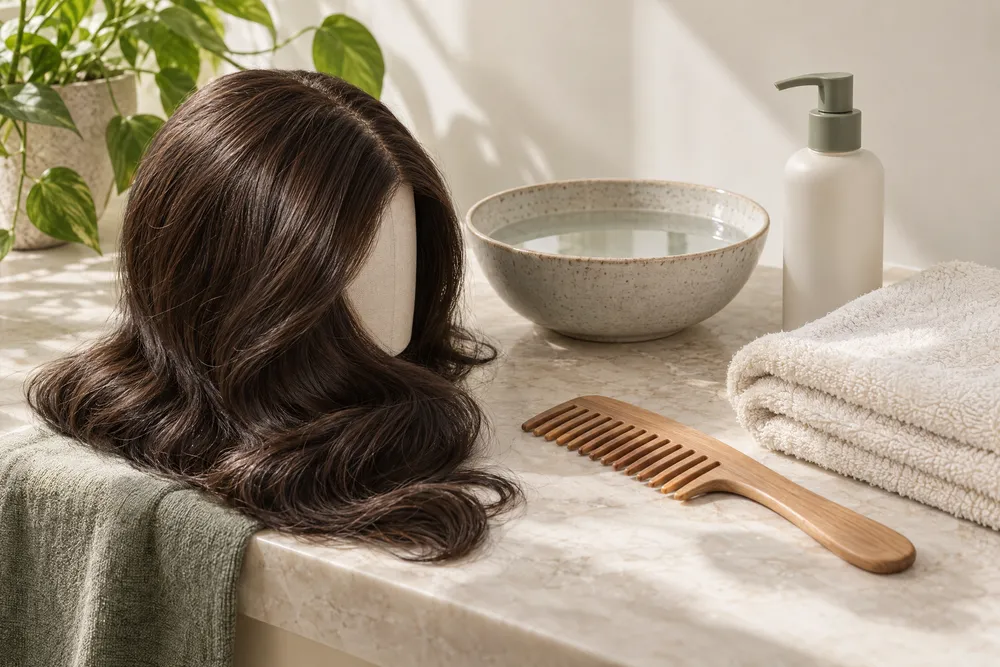

Choosing conditioner for wigs by fibre type
Start with what the wig is made from, not with a familiar bottle from your own bathroom. Human-hair and synthetic fibres can have different care requirements, and blended fibres may need their own instructions. Cancer Research UK describes human-hair and synthetic wigs as distinct types and advises following the supplier's care instructions; that is a useful general reminder, not a product-specific recommendation or endorsement. Read its wig guidance.
Check whether conditioner for wigs suits the fibre
Look for the exact fibre named in the wig's care information, then check whether the conditioner explicitly says it is suitable for that type. If the label is written for human hair only, do not assume that it is suitable for a synthetic wig. Likewise, a product described as a wig conditioner is not automatically right for every fibre or every cap construction. If either label is missing or unclear, pause and ask the product supplier before applying it. This matters particularly for conditioner for synthetic wigs, where a product's intended use and directions should be clear rather than inferred from the word “conditioner”.
Think about the result you want as well as the fibre. A product intended to soften or smooth the lengths may be different from a detangling spray designed to help with brushing. Do not layer several products simply because the hair feels dry or tangled; build-up can make a style feel coated and harder to handle. If the main issue is knots in the lengths, compare the approach in our guide to wig detangler spray and choose one suitable product rather than combining formulas without checking their instructions. For general routines in Hong Kong's humid, changeable weather, see wig care Hong Kong; climate is a reason to consider how a wig is worn and stored, not a reason to ignore its label.
For heat-friendly synthetic fibres, care and styling directions are separate questions. A conditioner label does not establish that the wig can safely take heat. Check its specific heat guidance before styling and read heat friendly synthetic wig care before using heated tools. For a human-hair piece, the same caution applies: a conditioner does not itself make heat styling appropriate. See can you use heat on a human hair wig and follow the instructions for the exact wig.

How to apply conditioner for wigs without soaking the cap
A controlled application is easier to judge than soaking the whole piece. Prepare the wig as its washing instructions direct, keep the cap supported, and work with the hair in manageable sections. You do not need to saturate the base to condition the lengths; keeping product and unnecessary rubbing away from the cap helps protect the areas where the hair is secured. For advice beyond conditioner, browse our wig care guides and choose the topic that matches the rest of your routine.
Apply conditioner for wigs to the lengths, not the knots
First remove tangles gently, beginning at the ends and moving upwards while supporting the hair above the section you are handling. Follow the product's stated amount and application method. If it is a rinse-out conditioner, spread it lightly over the lengths as directed; avoid rubbing it into the cap, knots, lace or attachment points. Do not pull a comb through a snag or tug the hair while wet. A wide-tooth comb or fingers may be appropriate only if the wig's own care instructions allow them.
Keep the base from becoming needlessly wet. Hold the wig so the lengths are accessible and the cap is not immersed in conditioner, and avoid pouring product over the crown. If you wash the wig first, use the separate directions in how to wash a wig rather than treating conditioner as a substitute for washing guidance. A damp or tangled piece should be handled patiently: pause, support the section and work out only what releases easily. Do not scrub the cap to chase a smoother finish through the lengths.
If a spray is recommended for the fibre, apply it sparingly where the directions say to use it, usually across the hair rather than aimed at the base. Keep the nozzle far enough away to distribute the mist instead of concentrating a wet patch, and avoid spraying near adhesives or sensitive areas. Let the product work for the stated time, if any, then rinse or leave it according to the label. Once care is complete, allow the wig to dry in the manner specified for that piece. Storage comes afterwards: our guide to how to store a wig covers keeping a wig tidy between wears.

Rinse-out or leave-in conditioner for wigs: follow the label
The words “rinse-out” and “leave-in” describe how a product is meant to be used, not a guarantee that it suits every wig. Check the product directions together with the wig's own care information. Do not extend the contact time, dilute the formula or leave a rinse-out product in because the hair still feels dry; ask the supplier if the instructions do not answer your question.
Use leave-in conditioner for wigs only as directed
A leave-in conditioner for wigs should remain on the hair only when its label says it is a leave-in product and the wig instructions permit that type of care. Apply only the stated amount and to the stated area. More is not necessarily better: an excess can make the lengths feel tacky, flatten movement or transfer onto clothing. If a leave-in product is a spray, aim it carefully at the lengths and keep it away from knots, the cap and any attachment area. Do not spray directly onto a scalp or skin to test it, and do not assume that a product is suitable for sensitive skin.
If you want a light refresh between washes, check whether the product is actually intended for that purpose and how often its label allows use. A detangler and a leave-in conditioner can serve different purposes, so compare the instructions instead of treating them as interchangeable. For product-specific details and a clearer comparison, see our wig conditioner guidance. Ask the supplier about the exact item if the fibre compatibility, application area or frequency is not clear.
Rinse conditioner for wigs when the product instructions say to
Rinse-out conditioner should be rinsed as directed. Use the stated water and rinsing method in the wig-care and product instructions, and support the lengths so they are not twisted or dragged around. Do not leave residue just to avoid handling the hair, and do not continue rinsing in a way that conflicts with the wig's care guidance. The right routine is the one given for that product and construction, not a universal timing rule.
After rinsing, handle the wig gently and let excess water drain without wringing or rubbing the hair. Follow the wig's directions for drying and detangling; those steps may differ by fibre. If the lengths still feel coated, check that the product was fully rinsed as instructed before adding another formula. If the hair behaves unexpectedly, stop experimenting and seek advice from the supplier. Colour-changing plans are also separate from conditioning: review can you dye a human hair wig before considering a chemical change, and do not assume conditioning makes dyeing suitable.


| Product or situation | What to check | Where and how to apply |
|---|---|---|
| Conditioner for human-hair wigs | Confirm the wig's fibre and whether its care instructions permit the named product. | Follow the label on the lengths; keep product away from knots and cap areas unless the instructions say otherwise. |
| Conditioner for synthetic wigs | Use only a formula whose label and wig instructions identify it as suitable for that synthetic fibre. | Use the stated amount and method. Do not infer fibre compatibility from a general hair-care label. |
| Leave-in conditioner or conditioning spray | Check that it is genuinely leave-in, suits the wig fibre and gives directions for frequency and use. | Mist or spread sparingly over the directed area, not directly onto the cap, knots, attachments or skin. |
| Rinse-out conditioner | Check the specified contact and rinse directions against the wig's care information. | Apply gently to the lengths and rinse as directed, supporting the hair instead of rubbing or wringing it. |
Ask OWNSTRAND about a care product
Tell us the style you have in mind. We can discuss the options, quotation and arrangements before you decide.
Ask OWNSTRAND about a care productBefore you choose
Can I use regular hair conditioner on a wig?
Do not assume that an ordinary hair conditioner is suitable. Check the wig's fibre and care instructions, then use a conditioner only when its label says it is appropriate for that fibre and the directions fit the wig. If the product is not clear about wig use, check with its supplier before applying it.
How can I condition a wig without loosening the knots?
Follow the product directions and work gently on the lengths, keeping conditioner away from the cap, knots and attachment points. Support the hair as you handle it, and avoid rubbing, twisting or pulling—especially when it is wet. Keep the base from being soaked unless the wig's own instructions specifically call for that method.
Should leave-in conditioner for wigs be rinsed out?
Use the label. A product intended to be left in should remain only if its directions say so and the wig-care instructions allow it. Rinse-out conditioner should be rinsed as directed. Do not decide from the product name alone if its label is unclear.
Can I use conditioner for synthetic wigs?
Only use a product that the wig's care instructions and conditioner label identify as suitable for that synthetic fibre. Directions can vary between products and wigs, so do not substitute an ordinary human-hair conditioner or apply an unlabelled product by guesswork. For product selection, WhatsApp +852 5933 4697.
Further reading
- Wigs, hats and scarves | Cancer Research UKSupports the general distinction between human-hair and synthetic wigs and the advice to follow the wig supplier's care instructions; it does not prescribe a conditioner or endorse OWNSTRAND or a particular product.
Still weighing up your options?
Follow a related guide to make your next decision with clearer information.

Can you dye a human hair wig? It depends on its history and maker’s care guidance. Check before colouring, bleaching or perming; ask us about your wig.
Browse practical wig care guides from OWNSTRAND Wigs, including washing, storage, detangling and everyday wear considerations for different fibres.
Explore wig detangler spray guidance for synthetic and other wig fibres. Check each product label for suitability and ask OWNSTRAND about options.
Learn how to wash a wig and how often to wash a wig, with fibre-aware steps and practical Hong Kong care tips. Ask OWNSTRAND about your wig.