

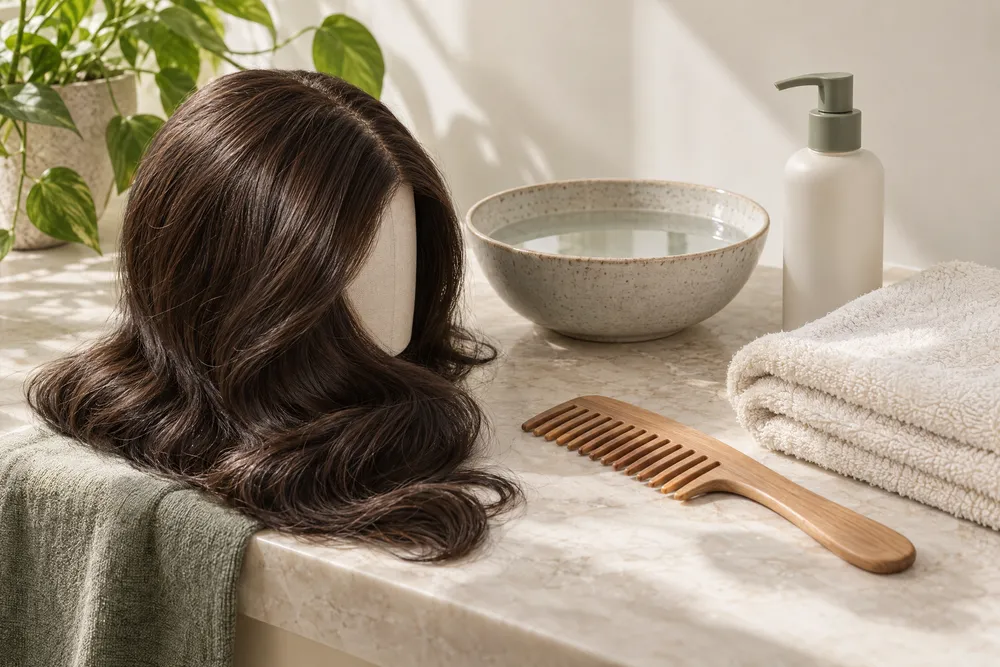
Regular Synthetic vs Heat-Friendly Synthetic Wigs: Key Differences
The practical distinction is the degree of styling flexibility the maker permits, not a promise that one fibre will suit every wearer or last longer. Treat “heat-friendly” as a prompt to check instructions for that exact item. It does not mean unrestricted heat resistance, and a regular synthetic label does not tell you how to restyle the wig with hot tools.
Regular Synthetic vs Heat-Friendly Synthetic Wigs: What to Check
A regular synthetic wig is best approached as a style whose shape and finish should be maintained according to its care directions; do not assume that a curling iron, straightener or heated brush can be used. If you want a different look, check whether the maker describes any permitted styling method rather than testing heat on a small section. A fibre can be damaged by an unsuitable method, and an experiment may change the appearance of the wig without an easy way to restore it.
A heat-friendly synthetic wig can offer an additional option when its instructions specifically allow a heat tool. The permission is not interchangeable between brands or styles: the acceptable tool, technique and maximum limit must come from the information for that piece. If no limit or method is given, regard the detail as unknown, not as permission to choose a low setting yourself. Ask for the product-specific instructions before buying if heat styling is central to your decision.
The finish you see in a product image is also not proof that a style is intended to be restyled. A smooth look, curl or bob shape can be part of the design as supplied. If preserving that look with minimal intervention matters to you, compare the silhouette and the maker’s care steps rather than assuming greater heat tolerance is automatically an advantage. If you are considering a heat-permitting category, browse heat-friendly synthetic wigs and check the individual product details instead of relying on the category name alone.
A useful comparison from the American Cancer Society is that wig choice involves fibre type and the care or styling directions for the specific wig; its general guidance is not a specification for a particular item. That supports a practical rule here: check the named fibre and maker’s instructions together. It does not mean the Society endorses any retailer or product. For the distinction among material categories beyond this comparison, see wig hair types.

How styling and care depend on the fibre
Care is part of the choice, not an afterthought. Before deciding, picture an ordinary day with the wig: how you will put it away, keep its shape and respond if it needs attention. The more you expect to alter its style, the more important it is to have clear, item-specific permission and instructions.
Follow the care instructions for the specific wig
For either category, follow the care label or instructions supplied for the exact wig. Use the recommended washing and drying approach, and handle the fibre in the way the maker describes. Do not substitute a routine intended for human hair or another synthetic style simply because the materials look similar. If care information is missing, ask what products and methods are permitted before washing, brushing or applying heat.
Heat-friendly does not mean heat-proof. It also does not establish that every tool, every styling technique or repeated restyling is suitable. The maker’s instructions are the authority for whether heat can be used, at what stated limit and how to apply it. Where the information is unclear, avoid heat until the details are confirmed. For a more focused checklist, read heat friendly synthetic wig care; keep the exact wig’s own directions to hand when caring for it.
Think about the trade-off in everyday terms. If you are happy to wear the provided shape and want a straightforward choice, a regular synthetic style may meet your styling expectations without heat being part of the routine. If changing the look with a hot tool is important, a heat-friendly label may be relevant—but only when the product’s instructions support the tool and method you plan to use. If you do not want to manage heat limits, do not choose a style on the assumption that you will need to restyle it later.
Hong Kong shoppers may also want to compare how clearly a retailer presents fibre and care details before making a decision. The local guide to synthetic wigs Hong Kong can help frame that comparison. It is sensible to distinguish a general category description from confirmed details for a particular style; availability, product specifications and supply should be checked for the item you are actually considering.

What to check before choosing a synthetic wig
Choose around the result you want and the care you are comfortable following. A clear comparison should tell you what the fibre is, whether the maker permits heat and what information still needs checking. These points are more useful than the label alone when comparing standard synthetic wigs with a heat-tolerant option.
Questions to ask about heat styling
Ask three concrete questions before choosing. First, what is the exact fibre category for this style, and does the maker explicitly allow heat styling? Second, if it is allowed, what is the stated limit and which tools or methods are covered? Third, what care steps should you follow before and after styling, and where can you refer to them later? A complete answer should relate to the specific wig, not a general statement about all synthetic fibre.
Then compare the answers with your preferred finish. If you want a set shape and do not plan to use hot tools, compare the supplied style, fibre description and care routine. If you want to alter curls or smoothness, do not treat the words “heat-resistant” or “heat-friendly” as a safe temperature. Those terms may describe heat-tolerant synthetic options, but the wording alone does not state a limit. Ask for the individual product instructions before purchase or use.
If you are weighing synthetic against a mixed-material alternative, human hair synthetic blend wigs are a separate category worth evaluating by their exact fibre composition and care guidance. For a broader comparison of the trade-offs between fibre types, use human hair vs synthetic wigs and, for routine care differences, human hair vs synthetic wig care. These comparisons help clarify what kind of upkeep you prefer; they do not replace the instructions for an individual wig.
Finally, when considering a shop, check whether it can explain the exact fibre, care directions and any limit before you commit. The guide to compare wig shops in Hong Kong offers a wider checklist for evaluating clear product information. OWNSTRAND Wigs’ confirmed address is Unit 2103, 50 Hoi Yuen Road, Kwun Tong, Hong Kong (利寶時中心). For a question about a particular style, WhatsApp +852 5933 4697 is for enquiries, quotations and confirming supply; a message does not itself place an order.




| What you want to know | Regular synthetic | Heat-friendly synthetic |
|---|---|---|
| Heat styling | Do not assume hot tools are permitted; follow the maker’s exact instructions. | May be permitted only when the instructions for that style allow it. |
| Temperature or tool limit | Do not infer a safe limit from the category name. | Use only the stated, product-specific limit and permitted method; if absent, ask. |
| Best comparison question | Does the supplied shape and care routine suit how I want to wear it? | Do the confirmed heat permissions match the styling I actually plan to do? |
| Care decision | Follow the exact wig’s washing, drying and handling guidance. | Follow the exact wig’s care guidance before and after any permitted styling. |
Ask about a style or its care instructions
Tell us the style you have in mind. We can discuss the options, quotation and arrangements before you decide.
Ask about a style or its care instructionsBefore you choose
What is the difference between regular synthetic and heat-friendly synthetic wigs?
They are separate synthetic fibre categories. Heat-friendly styles may allow heat styling within product-specific limits, while regular synthetic fibres should not be assumed to tolerate heat. Check the care instructions for the exact style and treat an unstated limit as unknown. The right comparison is whether the permitted care and styling match how you want to wear the wig.
Can I use a curling iron on a heat-friendly synthetic wig?
Only if the maker’s instructions for that particular wig allow a curling iron and specify a safe limit or method. Do not assume one temperature applies to every heat-friendly fibre or transfer a limit from another style. If instructions are missing or unclear, ask for clarification before applying heat.
Are heat-resistant and heat-friendly synthetic wigs the same?
The terms can be used for heat-tolerant synthetic options, but the wording alone does not establish a safe temperature, permitted tool or styling method. Look for the individual product’s care guidance and confirmed heat limit. A broad category label is not a substitute for those details.
Should I choose a heat-friendly wig if I do not plan to use hot tools?
Not necessarily. Compare the style as supplied, fibre details and care routine with what you want from the wig. Heat tolerance only matters if it provides a styling option you expect to use, and it still comes with product-specific directions. A regular synthetic option may be a better match if its supplied shape and permitted routine suit you.
Further reading
- American Cancer Society — Wigs for Hair LossGeneral factual support for comparing wig fibre types and following the specific wig’s styling and care guidance. The article uses this only as general selection guidance, not as an endorsement or product-specific specification.
Still weighing up your options?
Follow a related guide to make your next decision with clearer information.
Explore synthetic wigs Hong Kong with a practical guide to comparing fibre, cap details and suitability. Ask OWNSTRAND about a style before visiting.

Explore human hair synthetic blend wigs and compare fibre considerations. Confirm each style’s materials and availability with OWNSTRAND Wigs before enquiring.
Explore wig hair types, including human hair, synthetic and heat-friendly fibres, and compare care and styling considerations. Ask OWNSTRAND about options.
Compare human hair vs synthetic wigs by fibre, styling considerations and care. Explore what suits your preferences and ask OWNSTRAND about options.