
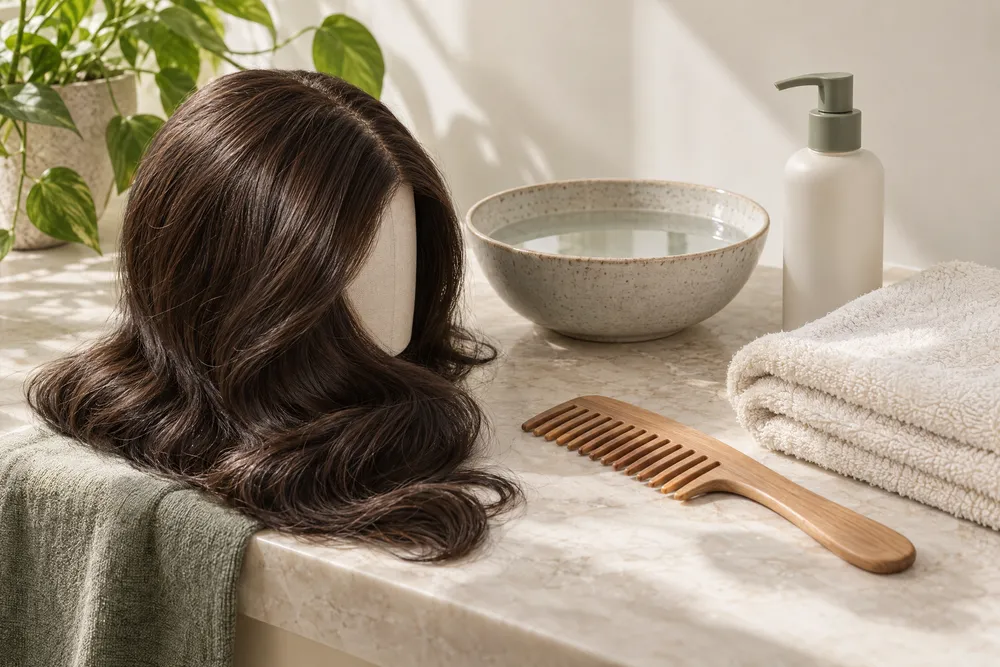
How to choose shampoo for human hair wigs
Treat the care label as the starting point, not the front of the shampoo bottle. It tells you which instructions belong to the piece you actually own, while a product’s broad marketing description cannot establish suitability for every human-hair wig.
Shampoo for human hair wigs: start with the care label
Before choosing a human hair wig shampoo, identify the guidance for your exact wig. Check any booklet, tag or care card supplied with it, including whether washing at home is recommended, what cleanser to use, how to rinse, and how the piece should dry. Keep those instructions together with the wig so they are easy to consult next time. If the label is missing, incomplete or difficult to interpret, ask the supplier or maker rather than applying a routine intended for another piece.
That distinction matters because “human hair” describes the fibre, not every detail of a wig’s construction or finish. Two wigs made with human hair can have different care requirements. A shampoo that seems mild, salon-quality or suitable for your own hair is not automatically suitable for a wig. Likewise, the phrase “wig shampoo” on a bottle is a useful prompt to read further, not a substitute for product-specific guidance. A label reading “wig shampoo for human hair” still does not remove the need to check your own wig’s care directions. Our separate guide to wig shampoo can help you compare the category, while the instructions for your own piece remain the deciding reference.
If you are shopping for more than one kind of hairpiece, keep fibre types separate in your decision. Guidance for a human-hair wig should not be transferred to a synthetic one: read our comparison on shampoo for synthetic wigs before caring for a synthetic piece. The same principle applies when you are planning styling or colour changes. Check can you use heat on a human hair wig and can you dye a human hair wig as separate questions, because shampoo choice alone cannot tell you whether heat or colour treatment is suitable.
Questions to ask before using a regular shampoo
If you already own a regular shampoo, do not decide by comparing only the bottle’s claims with your hair-care routine. Ask: does the wig maker name this type of cleanser, or clearly permit regular shampoo? Does the label give a washing method that the product can follow? Is there any instruction to avoid a particular ingredient or product class? If the answer is unclear, pause and ask the retailer or maker about that specific wig and cleanser before washing.
A “sulfate-free” claim is not a universal pass, and a “moisturising” or “gentle” claim does not establish that the formula is right for a particular wig. Those descriptions tell you how a product is marketed; they do not replace the wig’s care directions. The same caution applies to salon products and products you have used successfully on natural hair. The best shampoo for human hair wigs is therefore not one formula that can be recommended for every piece, but the cleanser the maker specifies or confirms for the wig in question. When choosing shampoo for a human hair wig, use that individual piece’s care label as your starting point.
When asking for guidance, make the comparison concrete: share the exact wig model or its care label, the full name of the shampoo and any relevant washing directions. That gives the supplier a useful basis to answer instead of guessing from the words “human hair” alone. Cancer Research UK advises that a wig supplier should provide instructions for wearing and caring for a wig and that those instructions should be followed carefully; this supports checking the supplied care guidance rather than relying on a general rule (Cancer Research UK).
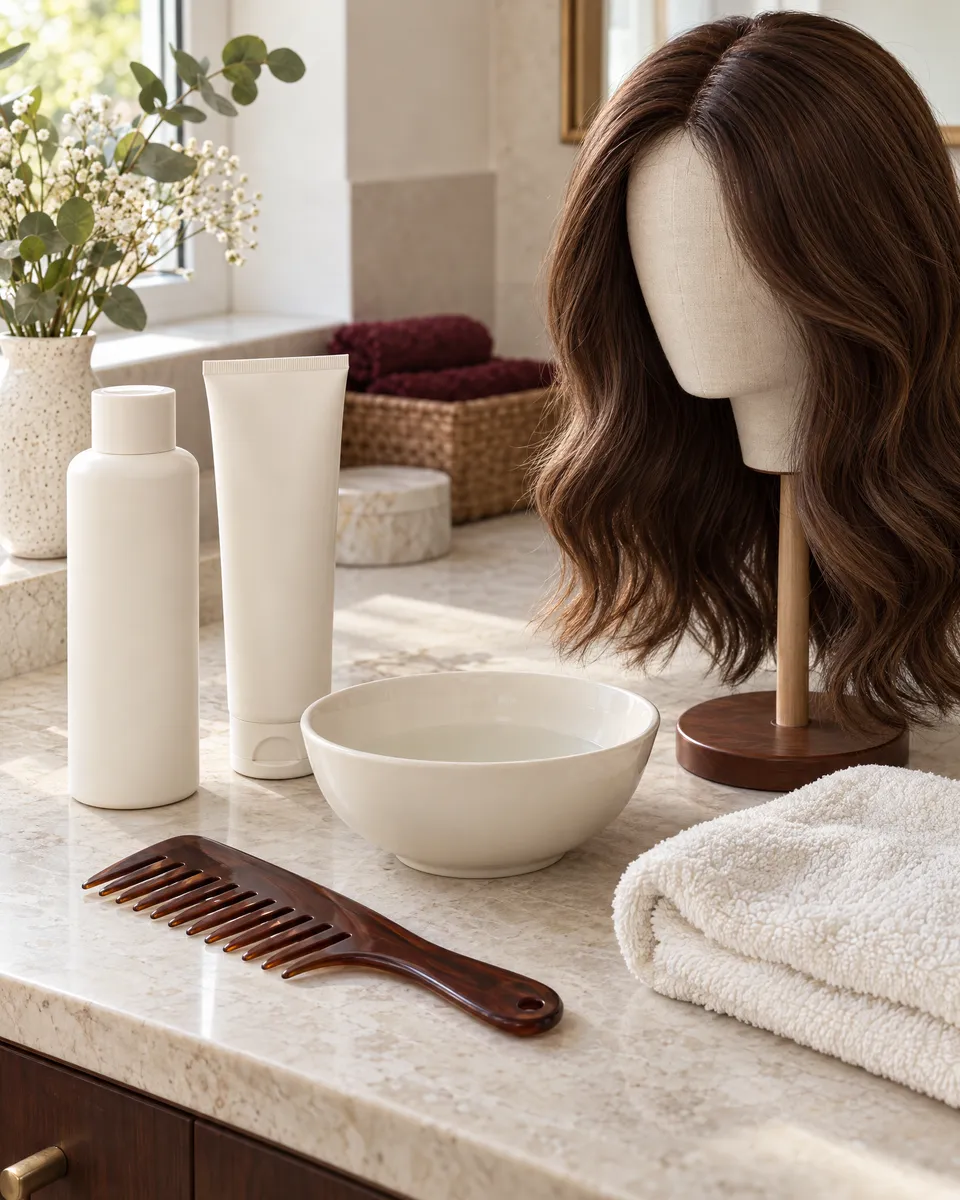
What to check on a cleanser label
Once the wig’s directions are in front of you, use the cleanser label to check whether the product and method line up. A short, practical comparison is more useful than choosing by a single headline claim.
Rinse and handle the hair according to maker guidance
Read the complete product directions and compare them with the wig maker’s instructions. Check how the shampoo should be diluted or applied, how long it should remain on the hair, and how it should be rinsed. If the product directions call for a technique that conflicts with the care label, do not improvise a compromise. Ask which instructions to follow. Avoid assuming that a cleanser is suitable just because its label says “for wigs”; confirm whether it is intended for the human-hair wig you have.
Rinsing and handling are part of the product choice. A cleanser is only practical if you can use and remove it in the way the maker specifies. Do not scrub, rub, twist or pull at the hair unless the instructions explicitly say to do so. Follow any directions about keeping water away from particular construction areas, how to support the piece while wet and what to do after rinsing. Where no method is provided, ask the maker rather than filling the gap with a routine for your own hair.
A useful three-check pause before washing is: first, does the wig’s care guidance permit home washing; second, does it specify or allow this cleanser; and third, can you follow the stated rinse and drying steps without conflicting directions? If any answer is uncertain, keep the bottle closed while you check. For ongoing care between washes, the wig care Hong Kong guide and our notes on wig frizz in humidity address other practical decisions without changing the shampoo instructions for your particular piece.

A gentle washing routine for a human hair wig
There is no single set of washing directions that fits every human-hair wig. Use the sequence below as a way to organise the task, and let the maker’s care label determine the actual product, water conditions, handling and drying method. Once the piece has been cared for and dried as directed, use the separate guide on how to store a wig for storage ideas.


| Choice or claim | What it tells you | What to check before washing |
|---|---|---|
| Cleanser named by the wig maker | The strongest starting point for that specific piece. | Follow the maker’s directions for amount, application, rinsing and drying; confirm any unclear step. |
| Regular everyday shampoo | It may be formulated for natural hair rather than the wig’s construction or finish. | Use only if the wig’s instructions permit it or the maker confirms this exact product is suitable. |
| Sulfate-free or labelled gentle | A product description, not a guarantee of compatibility with every wig. | Check the full formula directions against the care label; do not rely on the claim alone. |
| Product marketed as wig shampoo | It is presented for wig care, but that label may not settle suitability for every fibre or piece. | Confirm it is appropriate for your human-hair wig and follow its maker’s washing method. |
| Directions missing or contradictory | There is not enough information to choose safely by guesswork. | Pause and ask the wig maker or retailer about the particular wig and cleanser. |
Ask OWNSTRAND about wig care
Tell us the style you have in mind. We can discuss the options, quotation and arrangements before you decide.
Ask OWNSTRAND about wig careBefore you choose
Can I use regular shampoo on a human hair wig?
Do not assume regular shampoo is suitable for every human-hair wig. Check the care label for your specific piece and follow its instructions. If the label does not clearly permit the shampoo, ask the maker or retailer before washing.
What is the best shampoo for human hair wigs?
There is no single best shampoo for every human-hair wig. Use the cleanser specified by the maker, or ask the maker or retailer to confirm that a particular product is suitable for your wig. A bottle marketed as a wig shampoo is not, by itself, a substitute for that check.
Is a sulfate-free shampoo always suitable for a human hair wig?
No. Sulfate-free is a product claim, not a universal suitability guarantee. Follow the care label and the maker’s guidance for the individual wig, even if you normally prefer sulfate-free products for your own hair.
Where can I ask about wig-care product suitability?
You can send OWNSTRAND an enquiry on WhatsApp at +852 5933 4697. Share the wig’s care instructions and the cleanser you are considering so the question is specific. WhatsApp is for enquiries, quotations and confirming supply; a message does not itself complete an order.
Further reading
- Cancer Research UK — Wigs, hats and scarvesThe source says a wig supplier should provide instructions on wearing and caring for a wig and advises following those instructions carefully; cited here only to support the general practice of using the supplied care guidance, not as product-specific shampoo advice or an endorsement.
Still weighing up your options?
Follow a related guide to make your next decision with clearer information.
Wig frizz in humidity varies by fibre and style. Learn what to check for human-hair and synthetic wigs, and ask OWNSTRAND Wigs about care for a specific style.
Browse practical wig care guides from OWNSTRAND Wigs, including washing, storage, detangling and everyday wear considerations for different fibres.

Compare wig shampoo options for synthetic and human hair, and check which care products suit your wig before choosing. Contact OWNSTRAND to ask about availability.

Learn how to store a wig between wears and when a wig stand for storage may help. Compare drying and travel options, then ask OWNSTRAND about suitability.