

Start with timing and the purpose of the wig
The first decision is not a colour or a cap type. It is whether you want a familiar appearance, a lighter daily option, an occasional alternative, or simply time to decide. That purpose changes which questions deserve the clearest answer.
What do you want the wig to do in your ordinary week?
Write down the settings that matter: a quiet day at home, a commute, visits, work calls, meals out, or a formal occasion. Then turn each setting into a practical question. Will the style still feel manageable when you have little time? Does the fringe, parting or length need to resemble your current look, or would a deliberate change feel more comfortable? This is a preference record, not a prediction of how treatment will affect you.
Ask your care team about the treatment timetable and any hair-loss information that applies to you; that clinical conversation is separate from choosing a style. If you are considering a wig before chemotherapy, use the interval before appointments to gather photographs, not to force a purchase. The American Cancer Society notes that planning ahead can help someone match a current hairstyle and colour before hair loss, while a wig can also be chosen later. American Cancer Society guidance explains both options.
Make one final timing question explicit: “What must I decide now, and what can I compare after I have seen the cap and colour in person?” A clear answer protects against confusing a schedule with a requirement to choose immediately. It also leaves room to revise a visual preference after seeing how a wig sits at the hairline.
- Name the two or three situations in which you expect to wear the wig most often.
- Separate a wish to match your present style from a wish to try a new one.
- Keep treatment timing questions with your healthcare team and product questions with the supplier.
Build a record before comparing styles
Memory is a poor colour chart, especially under shop lighting or when you are tired. A small record lets you explain a preference without treating one selfie as proof of an exact shade, density or fit.
Which photographs and notes are genuinely useful?
Take a front, side and back photograph of your everyday hairstyle in daylight near a window, without a filter. Add a close view of the parting only if that detail matters to you. Note your usual part, fringe direction, length around the face and whether you normally tuck hair behind the ears. The American Cancer Society similarly suggests photographs and natural light when someone wants to match present hair and colour. Those references guide a conversation; they do not certify a final colour match.
Put two contrasting reference looks beside your own photographs: one that feels close to you and one that shows a feature you do not want. That makes your language more precise than “not too dark” or “not too full.” If you are deciding how to start the conversation, custom wig salon vs online Hong Kong can help frame what to ask about seeing samples, measurements and follow-up questions. The comparison is about the process that suits you, not a claim that either route automatically produces a better result.
A note can also state what a photo cannot show: indoor warmth, the feeling of a cap, how a part moves, or how you respond to the weight after several hours. Listing those unknowns is productive. It becomes a request to check them, rather than an assumption that an image has answered them.
- Use daylight photographs with your normal part and styling.
- Write one feature to keep and one feature to avoid for each image.
- Mark what remains unknown until you inspect or try a specific wig.
| What to record | Why it matters | Question to ask |
|---|---|---|
| Front, side and back images in daylight | Shows the silhouette and usual parting | Which sample gives a similar outline from more than one angle? |
| Usual part, fringe and ear placement | Highlights the details you notice first | Can the part or fringe be positioned and checked before I decide? |
| Typical wearing settings | Connects the choice to your routine | What care or restyling would this option need between those settings? |
| Features to keep and avoid | Replaces vague words with visual priorities | Which priority is realistic to assess on this particular wig? |
| Unknowns after looking at photographs | Stops a picture from becoming a promise | What can only be confirmed by handling or fitting this wig? |
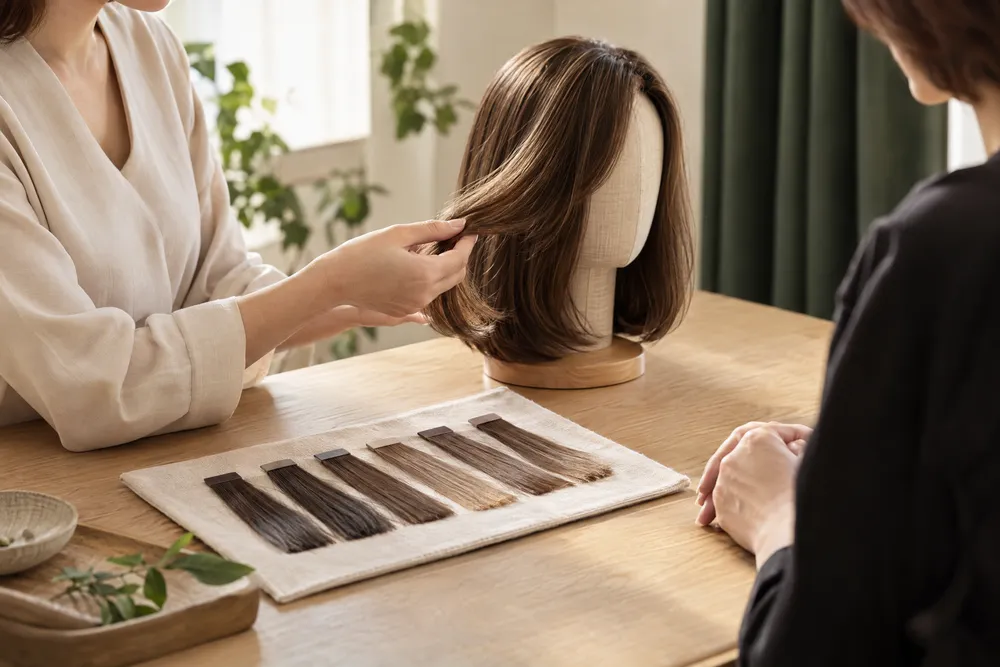
Ask fit and cap questions before choosing construction
A style may look promising on a stand and still require a different size, adjustment or construction for you. Fit questions should describe what you feel and see, then ask how the actual cap handles it.
How should I check the cap rather than just the hairstyle?
Ask where the cap should sit at the front, around the ears and at the nape, and whether it has adjustment features. If you try a wig while you still have hair, ask how its fit may differ if you later have less hair underneath. Cancer Research UK notes that people trying wigs before hair loss may need a smaller size later or an adjustable wig; it also recommends taking photos of pre-treatment hair to a fitter. Cancer Research UK’s wig information supports these practical questions.
Then ask to assess the parts you can observe: does the front sit where you expect, does the ear tab area feel settled, and does the nape remain comfortable when you turn your head? Do not convert a description such as lace-front, monofilament or hand-tied into a universal comfort promise. These constructions describe features, and the answer must relate to the actual product and your own fitting. A comparison of custom vs ready-made wigs is useful when you want to ask whether the priority is a standard size and selected style or a made-to-measure process.
Ask for the measurement method and the next step if your dimensions fall between sizes. Head measurements are a starting point, not a guarantee that every brand’s size chart will behave in the same way. Recording the response beside the name of the wig keeps a comparison fair.
Compare fibre, colour and routine as one choice
Material affects the routine attached to a wig, while colour and cut affect what you see first. Treat them as connected choices. A beautiful swatch is less helpful if its care needs do not suit the time and conditions you expect.
Which questions reveal the day-to-day trade-off?
Ask what the wig is made from, how the fibre is intended to be washed and dried, whether it has any specific heat restriction, and which instructions apply to that exact model. Cancer Research UK distinguishes synthetic, human-hair and mixed wigs, and says care and heat guidance should be checked against the manufacturer’s information for the particular synthetic wig. It also notes that custom real-hair wigs can require more time and fittings. That is why a material label alone cannot tell you what your own routine will be.
Put colour questions in normal language: “Does this look too warm beside my skin in daylight?” “Where does the root shade begin?” and “What happens to the contrast at the hairline?” Avoid asking for an exact replica based solely on a photo. If you would like to compare ready-made brand options, browse Ellen Wille wigs as a catalogue starting point, then confirm the construction, care guidance and availability of any individual item through an enquiry. A brand page does not make every option a self-made OWNSTRAND design or confirm stock.
If you prefer a made-to-measure human-hair direction, ask which details are part of the specific quotation and fitting discussion. OWNSTRAND’s three stated handmade human-hair custom options are the needle-insertion style, full needle-insertion style and Swiss-lace style; their construction descriptions should be discussed as those individual custom options, not assumed to apply to every original-brand wig.
- Ask for care and heat instructions for the exact wig, not for a fibre category in general.
- Check colour at the face and hairline in natural light where possible.
- Compare the maintenance you can realistically do with the look you prefer.
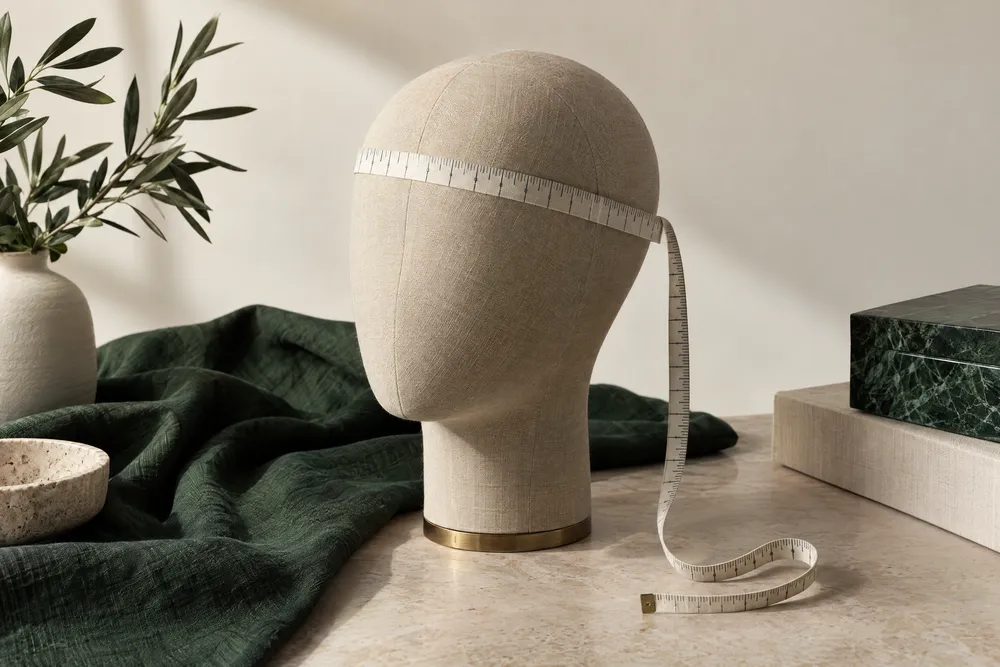
Clarify security, comfort and removal before adding products
A well-fitted wig may not need extra attachment, while another wearer may want additional security. Treat any accessory as a separate compatibility question. The goal is a clear use and removal plan, not the strongest possible hold.
What should I ask about tape, adhesive and removal?
First ask whether the chosen cap is designed to be worn without an attachment aid and how the supplier expects you to put it on and take it off. Dana-Farber explains that a well-fitted wig does not usually require aids, although some people prefer added security, and it advises seeking help from a wig store if securing it is difficult. Its How to Choose a Wig guidance also notes that scalp tenderness can occur when hair falls out. That is a reason to ask specific questions, not a reason to assume an accessory is suitable.
If tape is being considered, ask which area of this cap it is intended for, how long the chosen product is meant to remain in place, and what the removal sequence is. Read the product information for wig tape before treating it as an option for a particular construction. The fit, cap material and your circumstances all need confirmation. Never infer that a tape described for one use is appropriate for every lace or cap design.
For a liquid product, ask the same question in a different form: “Is wig adhesive relevant to this wig and, if so, what instructions govern application and removal?”
If a product is used, removal should be part of the original decision rather than an afterthought. Review the intended use of wig adhesive remover and follow the item’s directions. If you have scalp or skin concerns during treatment, seek individual advice from your healthcare team before trying a new product.
- Ask whether the cap needs an attachment aid at all before comparing products.
- Match any tape or adhesive discussion to the exact cap and intended wear pattern.
- Ask how removal works at the same time as asking about security.
Take a short question list to your next enquiry
A long list is only helpful if it separates facts you need confirmed from preferences you want to discuss. Keep the list short enough to use while looking at a specific wig, then write down the answer next to that item.
Which questions lead to a clearer next step?
Start with five: Which option best matches the look I recorded? How should this cap be measured and adjusted for me? What fibre-specific care applies to this item? What can be checked now, and what must wait for fitting? If I want added security, is it appropriate for this cap and how is it removed? Each question asks for an observable answer rather than a promise about every day or every stage of treatment.
Bring your photos, your one-page record and the names of the styles you compared. For a local conversation, use Hong Kong wig enquiries to ask OWNSTRAND about the option you are considering. The enquiry can clarify a quotation, sample-viewing or fitting question; it is not a payment process, a reservation guarantee or proof that a particular style is available. If you choose one of OWNSTRAND’s custom human-hair options, ask what the measurement, production and return-fitting steps mean for that individual order.
After the discussion, compare notes using the same headings: fit, appearance, care, security and unresolved questions. The choice becomes more manageable when you can see what has been confirmed for a named wig and what still depends on seeing or fitting it.
- Carry photographs, a preferred-look note and a list of unknowns.
- Ask answers to be tied to the individual wig or custom option under discussion.
- Keep unresolved points visible instead of filling gaps with assumptions.

| Decision area | Question to ask | What a useful answer should clarify |
|---|---|---|
| Current look | Which parts of my hairstyle are realistic to compare from these daylight photos? | The features that can be assessed now and the limits of photographs. |
| Fit | How will this cap be measured, placed and adjusted for me? | Sizing method, adjustable features and what fitting can confirm. |
| Construction | What does this cap construction change in the way I can part, wear or care for it? | The specific feature on the named wig, not a broad promise. |
| Fibre and colour | What care and styling limits apply to this exact fibre and shade? | Model-specific care instructions and a chance to see colour in suitable light. |
| Security | Does this cap require an aid, and what is the approved removal plan if one is used? | Whether an accessory is relevant and how it is intended to be removed. |
Ask OWNSTRAND on WhatsApp
Tell us the style you have in mind. We can discuss the options, quotation and arrangements before you decide.
Ask OWNSTRAND on WhatsAppBefore you choose
Should I choose a wig before treatment starts?
You may choose before treatment if seeing your current hair helps you compare style and colour, but you do not have to decide immediately. Ask your care team about your treatment timetable, then use a supplier discussion to learn what can be assessed now and what may need fitting later.
What is the most useful photo to bring when choosing a wig?
Bring a small set rather than one perfect image: front, side and back views of your normal hairstyle in daylight, with no filter. Add notes about your usual part, fringe, length and the feature you want to keep or avoid. Photos support communication; they cannot confirm comfort or an exact final match.
Do I automatically need wig tape or adhesive?
No. A well-fitted wig may be worn without an additional aid. Ask whether a named cap needs one, whether the accessory is compatible with that construction, and how it is removed. If treatment-related skin or scalp concerns affect the decision, seek individual guidance from your healthcare team.
Further reading
- American Cancer Society: Wigs for Hair LossSupports planning ahead with photographs and natural light, measuring before hair loss, wig style and construction descriptions, and the distinction between synthetic and human-hair wigs.
- Cancer Research UK: Wigs, hats and scarvesSupports taking photographs, considering an adjustable size when trying a wig before hair loss, checking manufacturer guidance for synthetic-wig heat exposure, and allowing time for fitting.
- Dana-Farber Cancer Institute: How to Choose a WigSupports asking about fibre, construction and attachment, plus the point that a well-fitted wig does not usually require attachment aids.