

Decide what the base needs to cover before comparing its shape
Start with the appearance you want the base to address, not with a label such as small, medium, or full. The useful boundary is the area that looks sparse or exposed in your ordinary parting and hairstyle, viewed at a normal conversation distance.
Trace the visible boundary, then the usable edge around it
Stand in even daylight or another consistent light. Keep the part and styling you normally wear. In a mirror, identify the front point, back point, left edge, and right edge of the area you hope to disguise or add fullness to. These are observation points, not a self-diagnosis. A photo can help you remember where they were, but it cannot decide whether a particular base will be comfortable or secure.
Next, note where your own hair appears sufficiently present for a clip-based piece to be discussed. Do not treat the visible boundary and the possible attachment boundary as the same line. A specialised hair topper base size guide can help frame the two dimensions, but a listed size still needs to be read with its own finished edge and placement in mind.
This first distinction also clarifies whether a topper is the category you are trying to compare. The National Alopecia Areata Foundation explains that toppers are partial pieces that blend with existing hair, while full wigs provide total scalp coverage. Read hair topper vs wig as a separate coverage question when the area you want to address is no longer local to the crown or top.
Prepare light, photos, and notes that can be compared later
The aim is not to produce a flattering image. It is to make today’s notes understandable when you view another base shape, speak to a consultant, or revisit the question after your styling changes.
Use the same basic set-up for every reference image
Use a soft tape, a mirror, a phone camera, and a note page. Avoid filters, heavy flash, and a single overhead light that makes every part look wider. Take one view from slightly above the front and one from slightly above the back or crown. Keep your hair dry and arranged as you usually wear it. Add the date, the light source, and whether you wore a centre, left, or right part.
A HairToppers.com measurement guide similarly separates side-to-side coverage from front-to-back coverage and advises using a soft tape. Its important practical distinction is that the intended coverage area is not automatically the finished topper size. That supports recording the footprint first rather than choosing a shape from a name or a model photograph.
Include one close image only if it shows a transition you may want checked, such as the start of your part or the front edge of the visible area. A close image is useful for discussion, but it should not replace the wider view. The wider view shows how the proposed perimeter may meet your everyday hairstyle.
- Write the part direction and whether it changes during the week.
- Use the same light and camera distance for both top views where possible.
- Mark whether the front point is near the hairline, behind it, or clearly within the top area.
- Keep the raw images so that colour adjustment does not alter the apparent scalp contrast.
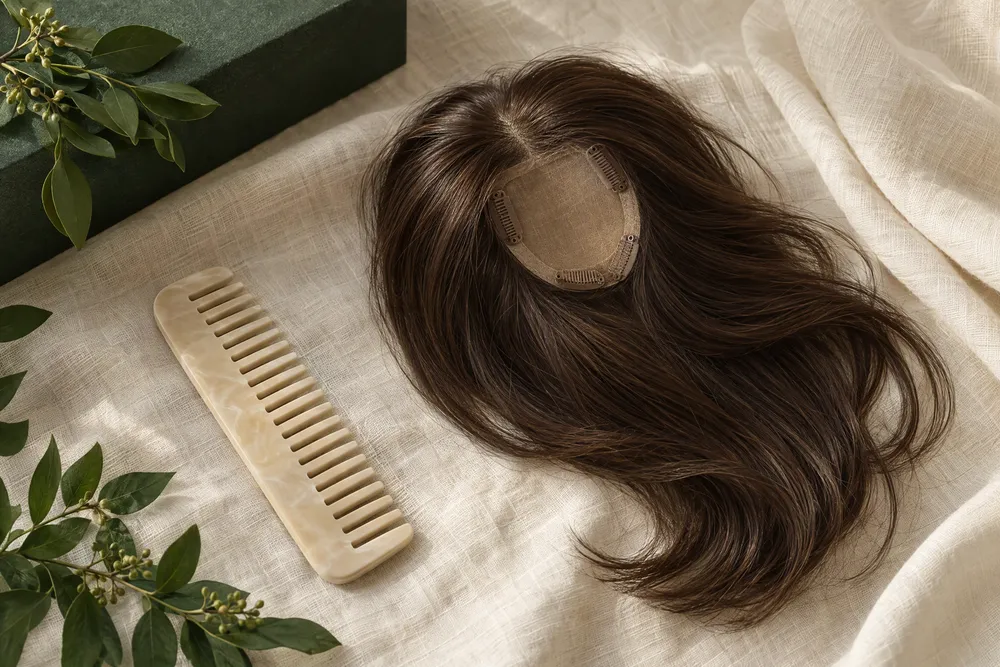
Record the footprint, part direction, and head contour separately
Two width-and-length figures are useful, but they do not describe everything a base outline needs to follow. Add simple directional notes so that the dimensions retain their meaning once you compare shapes.
Turn four points into an enquiry-ready record
Measure between the left and right points across the area you want covered, then between the front and back points. Keep the tape against the head surface rather than stretching it across open air. The purpose is to record the path you measured, not to create an exact universal size. Different makers state finished dimensions and edge construction in their own way, so do not assume one format is interchangeable with another.
Headcovers’ hair topper buying guide also recommends measuring the thinning area in both directions with a flexible tape and considering where clips land beyond that area. Use that as a prompt to ask where each specific piece is intended to sit. It does not prove that every base, clip layout, or wearer needs the same margin.
After the two measurements, add a part note: centre, left, right, shifting, or no defined part. Finally, describe the surface in plain language, such as ‘crown feels rounded’, ‘front area slopes down’, or ‘left side becomes fuller sooner’. These descriptions are not measurements, yet they prevent a flat product image from hiding the context of the numbers.
| Record | How to observe it | Why it changes the comparison |
|---|---|---|
| Coverage width | Follow the head surface from the left visible edge to the right visible edge. | Shows how far the outline must reach across the top. |
| Coverage length | Follow the surface from the front visible point to the back visible point. | Shows whether the outline needs more front-to-back reach. |
| Part direction | Note your ordinary part and whether it moves. | Shows where a parting space or edge may be most visible. |
| Attachment context | Mark where existing hair should be checked around the boundary. | Keeps coverage and possible clip placement from being confused. |
| Surface note | Describe the crown and slope in ordinary words. | Explains why equal dimensions may not sit alike on different heads. |
Compare outline and base construction without treating terms as guarantees
A shape label describes only part of what you see. Perimeter placement, parting space, clip arrangement, and the way the base is made may all affect the questions worth asking, but no label alone predicts the final appearance on an individual head.
Ask what the outline must leave visible
Place the record beside each candidate image. Ask whether its front edge would finish before, at, or beyond your recorded front point. Ask whether its widest area aligns with the widest part of the visible area, rather than merely comparing the listed width. A longer, narrower outline and a shorter, wider outline can share a similar area on paper while creating different boundaries beside your own hair.
Construction words should prompt a closer question rather than settle it. For example, a monofilament hair topper page may help you identify a construction term, but it does not establish that every item with a similar term has the same parting space, attachment layout, or fit. The National Alopecia Areata Foundation describes monofilament in wig caps as a fine transparent mesh where individual hairs are tied to mimic scalp appearance; the exact construction of a candidate topper should be checked from that item’s details.
The same care applies to a silk top hair topper. Do not use the phrase as a shortcut for assuming a particular outline, density, scalp effect, or level of comfort. Bring the measurement record back to the practical questions: where is the part likely to appear, where does the edge fall, and what is actually confirmed for this piece?
- Compare the front edge against your recorded front point, not against a model’s hairline.
- Compare the widest section against your own widest visible area.
- Ask for the actual clip positions and finished perimeter of the specific item under discussion.
- Keep construction vocabulary separate from unconfirmed performance claims.
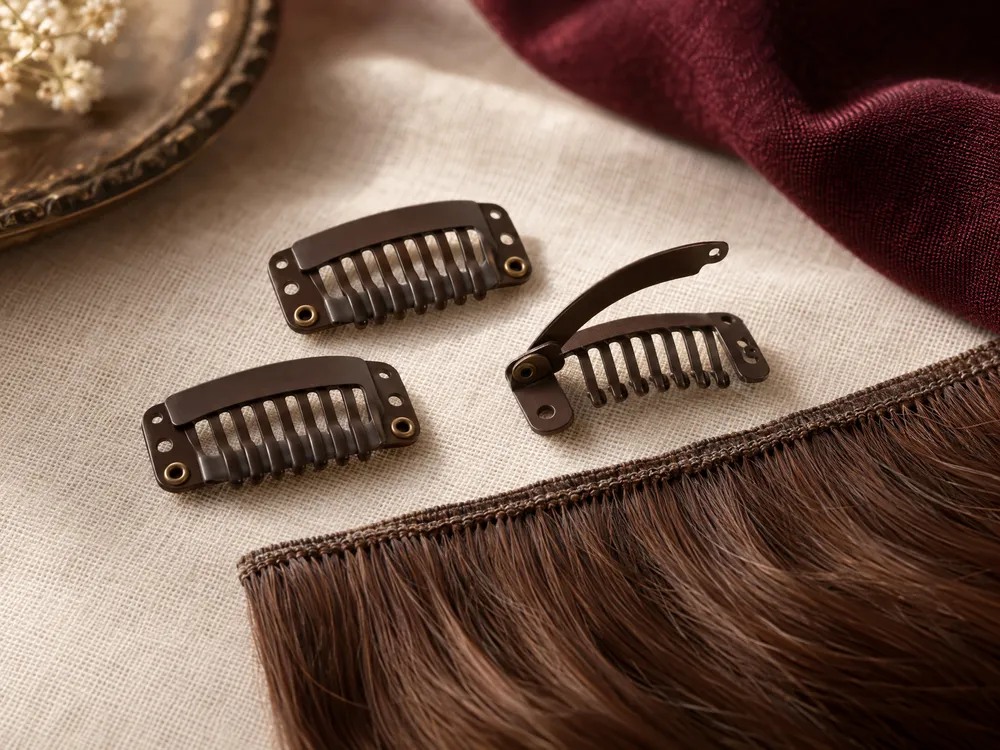
Turn the measurements into clear questions for a fitting conversation
The best outcome from measuring is not a self-selected answer. It is a short request that lets another person see what you observed, what you prefer to keep visible, and what must be confirmed against a real piece.
Use questions that connect each fact to a decision
Begin with the record: ‘My visible area is this wide and this long along the head, with a left part and a rounded crown.’ Then ask whether the candidate outline fully reaches those points without bringing the edge into an area you prefer to leave uncovered. Follow with a second question about where its clips are intended to meet your existing hair. This is more precise than asking only whether a base is ‘big enough’.
Blending belongs in the same conversation, but it is a separate visual task. After the outline is discussed, ask how the part direction, colour transition, length, and own hair around the edge may be reviewed together. how to blend a hair topper with natural hair can give you further wording for that second set of questions, without making a photo a promise of an identical result.
If cost affects which options you wish to discuss, keep the price enquiry specific to the actual option and any confirmed service. The hair topper prices page is a useful place to see what to ask before requesting a quote. A size note alone does not establish a price, stock status, or suitability.
| What you recorded | Question to ask | What the answer helps you compare |
|---|---|---|
| The visible area widens toward the crown | Does this outline reach the wider point without leaving a narrow gap? | Whether the widest part of the base is in the right place. |
| The part sits left of centre | Where would the parting space and front edge appear with my usual part? | Whether the visible transition matches daily styling. |
| The front point sits well behind the hairline | Can the front edge stay within the top area I recorded? | Whether the outline asks the piece to do a different job. |
| Attachment area looks limited on one side | Where are this item’s clips, and what should be checked in person? | Whether a photo leaves an important placement question open. |
| You want natural movement around the perimeter | How should my own hair and the edge be viewed together before I decide? | Whether blending is considered alongside coverage. |
Keep topper-base questions separate from different hairpiece decisions
Not every hair concern is solved by making a topper base wider or changing its outline. Separating the purpose of each piece protects the usefulness of the notes you have taken.
Do not use a crown record for an updo or full-coverage choice
A scrunchie hairpiece is an updo styling accessory, so its questions concern the look of a bun and how it works with your own tied hair. It is not a substitute for mapping top or crown coverage. Keeping that distinction clear avoids asking a perimeter question of a piece designed for a different visible area.
Likewise, a page about synthetic wigs for cancer patients addresses a different decision space: full-wig fibre options may be relevant to some people, while a topper comparison begins with existing hair and a local coverage map. Neither route should be assumed from a photograph of the crown. If changes in hair concern you medically, use an appropriate healthcare professional for that concern rather than a hairpiece record.
The simple test is purpose. If your notes describe a specific top area that you want to blend with existing hair, continue the base comparison. If you need total scalp coverage, an updo effect, or a question about fibre care, start a new set of questions for that purpose.
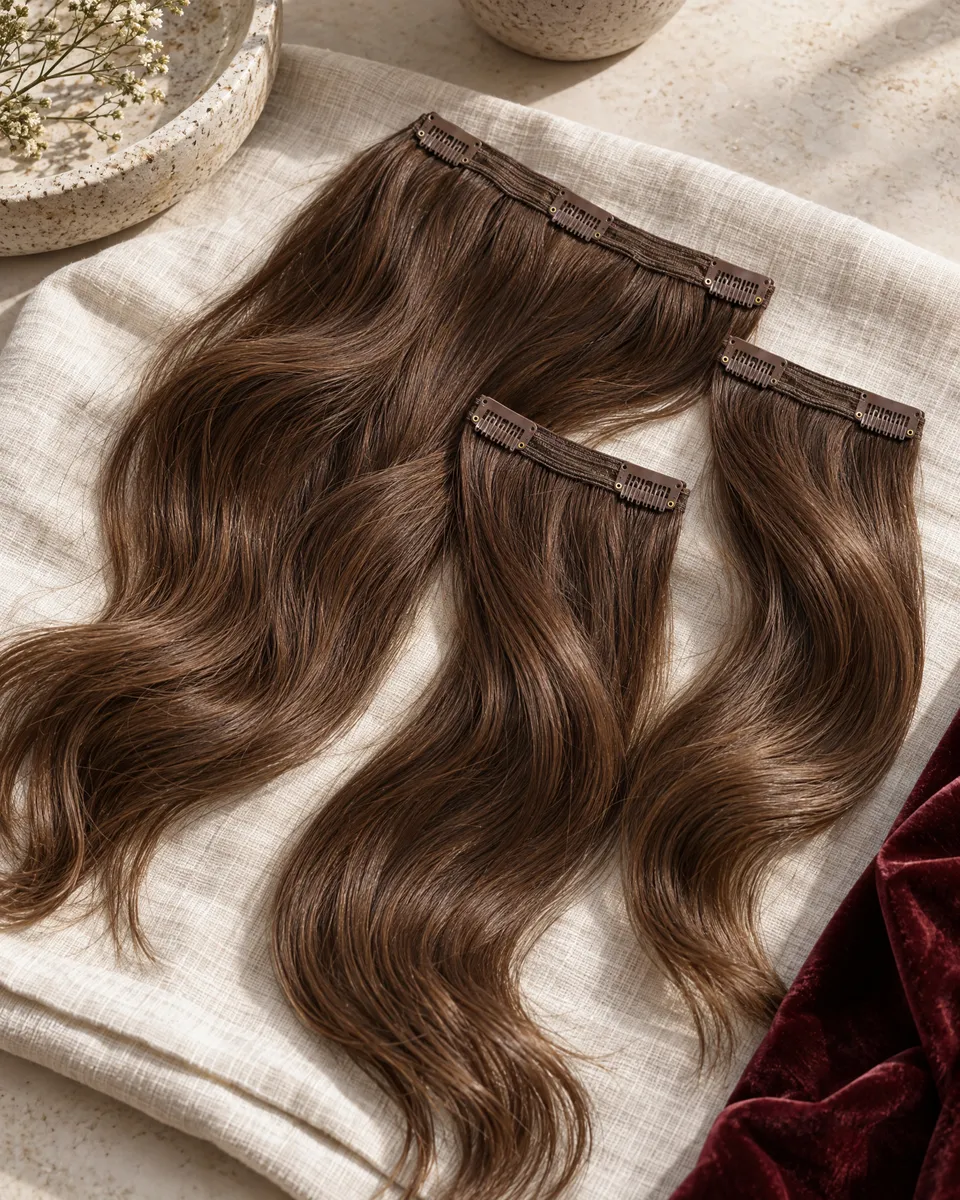
Spot the false signals that a photo or a number cannot settle
Measurements reduce uncertainty, but they do not remove it. Treat the remaining unknowns as points to check rather than filling them with assumptions about comfort, security, or how the edge will look in every setting.
Know which observations need a real-item check
A crown photographed from directly above may make a round surface appear flatter than it is. A strong ceiling light can also exaggerate contrast along a part. Re-check the same points in gentle, even light before deciding that the coverage area has changed. Likewise, a base photographed flat on a table has not yet shown how its perimeter meets the curve of your head.
Do not infer the exact clip placement, tension, texture match, colour match, or day-long feel from dimensions. Those are item-specific or wearer-specific questions. If your own hair is routinely worn down, up, or moved from side to side, put that routine in the note so the comparison is made against your real styling context, not a one-off pose.
- Do not compare images taken under different colour temperatures as if they show the same contrast.
- Do not convert a listed width and length into a promise that the perimeter follows your head shape.
- Do not assume one base construction or clip arrangement applies to every product using a similar label.
- Do not turn an appearance note into a conclusion about the cause of hair change.
Take a compact checklist to your next topper enquiry
You do not need a technical drawing to compare topper base shapes well. A small, consistent record gives an OWNSTRAND conversation a concrete starting point and leaves room to confirm the details of the exact option you are considering.
Bring the record, the photos, and three priorities
Bring the two surface-following measurements, the part direction, and your plain-language surface note. Add two unfiltered reference photos in similar light. Then list three priorities in order: the area you want covered, the edge you want least visible, and the daily hairstyle you want to keep. This turns ‘Which shape is best?’ into a question that has a visible context.
For an OWNSTRAND enquiry, say which of the four facts you recorded feels least certain and ask that point to be checked against the actual base. You may also state whether you are comparing a local topper with another category, but avoid assuming price, availability, construction, or care requirements until the particular option is confirmed. The purpose is a better conversation, not a remote fitting decision.
- Coverage width and length, measured along the head surface.
- Usual part direction and an ordinary description of crown contour.
- Two consistent-light photos that show the top from front and back.
- Three priorities and the one point you need checked on the actual item.
| Observation pattern | What not to assume | Better next question |
|---|---|---|
| The visible area is longer front to back than it is wide | That a narrow-looking base is automatically the right outline. | Where does this item’s front and rear edge sit against my recorded points? |
| The area spreads wider at the crown | That the listed overall width is enough without checking its widest point. | Does the widest part of this outline align with the crown area I mapped? |
| The part shifts from side to side | That one fixed parting position will suit every day. | What parting or edge detail should be reviewed for my usual styling changes? |
| One side has less obvious attachment context | That symmetric dimensions mean symmetric placement. | Where are this item’s attachment points, and what must be checked in person? |
| You want more visible top fullness without changing the hairline | That a larger base should extend to the hairline. | Can the perimeter remain within the top area I recorded while addressing the desired coverage? |
Ask OWNSTRAND on WhatsApp
Tell us the style you have in mind. We can discuss the options, quotation and arrangements before you decide.
Ask OWNSTRAND on WhatsAppBefore you choose
Should I measure my whole head before comparing topper base shapes?
Not as the first step for a local topper question. Start by mapping the specific top or crown area you want covered, the part direction, and the surrounding placement context. Whole-head measurements belong to a different full-wig sizing conversation.
Is the measured coverage area the same as the topper’s finished base size?
No. The coverage record states the area you want addressed. A finished base also has its own perimeter and attachment layout. Ask how the specific item’s stated dimensions and edges relate to your mapped area rather than assuming a one-to-one match.
Can I choose between round and rectangular base shapes from photos alone?
Photos can show your coverage pattern and part direction, but they cannot prove how an outline follows your head surface, where its clips sit, or how its edge blends in person. Use photos to prepare targeted questions, then confirm the details of the actual item.
Further reading
- National Alopecia Areata Foundation: Wigs and Toppers—Understanding the BasicsSupports the distinction between partial toppers that blend with existing hair and full wigs that provide total scalp coverage, plus the general description of monofilament cap construction.
- Headcovers: How to Choose a Hair TopperSupports measuring the visible thinning area front-to-back and side-to-side with a flexible tape and checking clip placement beyond the coverage area; item-specific margins and fit are not assumed.
- HairToppers.com: Everything You Need to Know About Hair ToppersSupports recording intended coverage separately in side-to-side and front-to-back directions, and distinguishing coverage measurements from finished topper size.