

Map the contact points before comparing liners
Glasses add two firm contact points beside the head. Before looking at a liner, identify what already touches those points and which contact becomes noticeable first when the temperature rises.
Separate the liner, cap, and frame-arm roles
Put on the wig as you usually would, without changing your glasses. With clean hands, note the route of each temple arm from the ear to the face. Then note the wig's ear tabs, adjustable areas, seams, and any grip already close to that route. The aim is not to diagnose a pressure point. It is to see whether an added liner would sit underneath a busy area or in a relatively clear one.
Use the product terms as a starting vocabulary rather than as a promise of one result. The overview of wig caps and liners can help you distinguish a full cap, a band, and other under-wig layers when asking about options. Record whether you need coverage across the whole scalp or only a low-profile layer around the perimeter. That distinction often changes the better question to ask.
Next, look at the order in which you dress. If the frames are put on after the wig, take a mirror note of whether the arms slide under loose fibres or catch the cap edge. If you remove glasses many times during a workday, repeat that motion slowly. A liner that feels fine while standing still may be less suitable if it bunches whenever the frames move. This is a fit observation, not a material verdict.
- Mark where each temple arm sits in relation to the ear tab or cap edge.
- Notice whether the first discomfort is behind the ear, at the nape, or along the hairline.
- Write down when glasses are worn: all day, only outdoors, or only for close work.
Balance airflow, grip, and thickness for the day ahead
Warm-weather comfort has competing needs. A more secure under-layer can add bulk, while a lighter layer may move more easily. Treat those as trade-offs to compare in your own setup.
Ask what the liner must do, and what the wig cap already does
Start by assigning one priority to the outing: reducing the feel of contact, keeping the wig from shifting during ordinary movement, or avoiding an extra warm layer. Do not expect one liner to maximise all three. The Breastcancer.org warm-weather wig guidance notes that a wefted back can allow airflow and that a thin wig band can reduce the feeling of cap pressure. Those observations make cap construction part of the decision, not an afterthought.
Material labels also need to be read in context. The National Alopecia Areata Foundation's guide to wigs and toppers describes mesh or elastic grips as lightweight options with airflow, while noting that they may not offer the same security for someone with no scalp hair. It also says silicone grips can feel sticky or warm for some wearers in hot conditions. This is why the same liner description can lead to different choices.
Thickness deserves its own check with glasses. Fold the liner at the point where the temple arm will sit and imagine that extra layer on both sides of the head. A smooth, thin edge may matter more than a soft centre panel if the glasses are worn continuously. Conversely, a liner that is very light but moves under the cap may create a different distraction. Ask to compare the edge, closure, and grip zone, not just the fabric name.
| What you notice | What it may mean for the next comparison | Useful question to ask |
|---|---|---|
| Temple arms feel crowded behind the ears | Added thickness at the sides may matter more than full-head coverage | Is there a flatter edge or lower-profile placement to compare? |
| The wig feels warm mainly at the back | Cap airflow and hairstyle length may be relevant alongside the liner | How does this liner sit with the existing back-cap construction? |
| The wig shifts when glasses are removed | The routine may need a stability check, not simply more fabric | Can the liner be assessed with my usual on-and-off glasses movement? |
| The scalp feels sensitive to seams | Seam position and finish deserve a close look | Where will the liner seam sit once the wig and frames are both on? |
| Comfort changes after a warm commute | A brief in-use check is more useful than a mirror-only check | Which option should I wear briefly at home before deciding? |
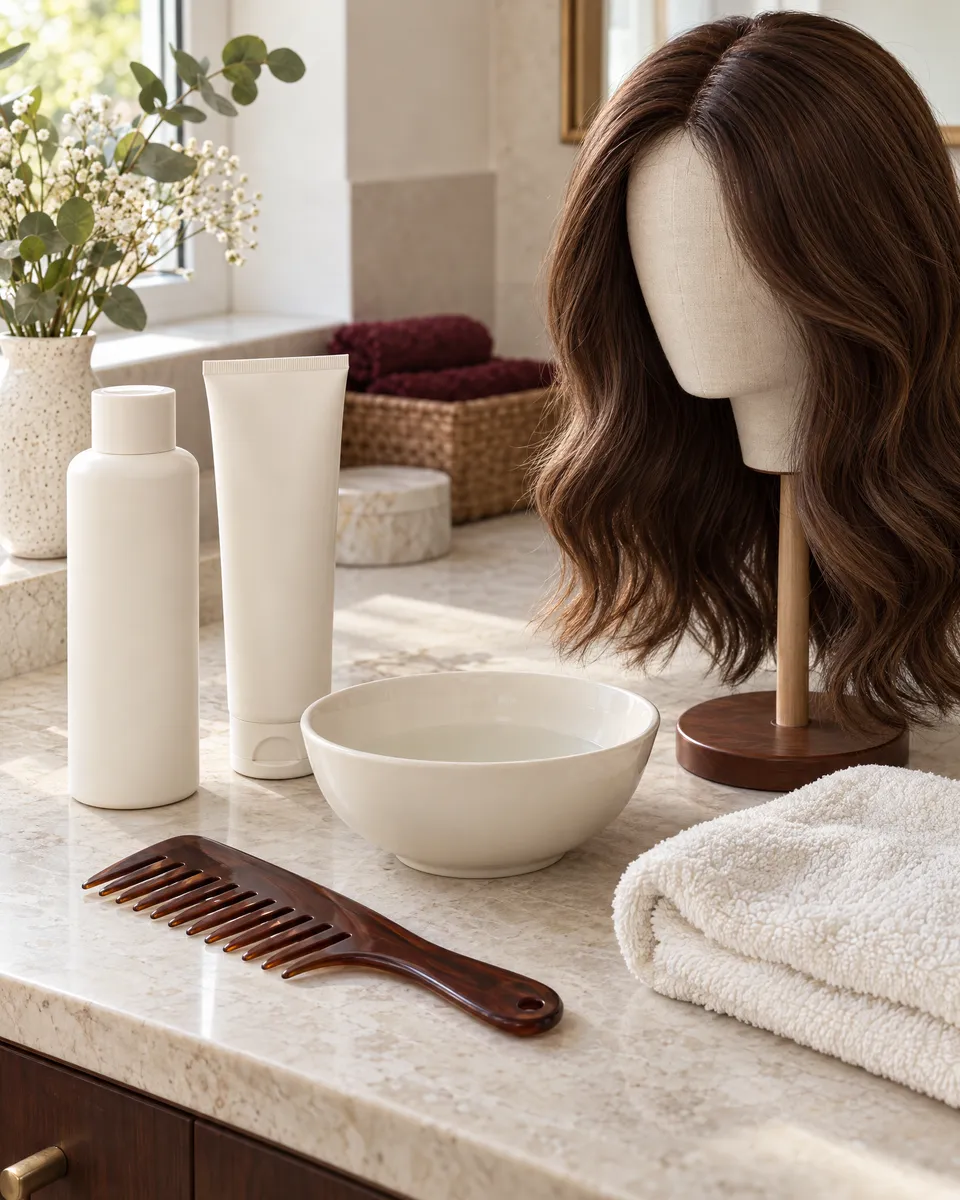
Run a repeatable glasses-and-warmth check at home
A short, controlled trial will not predict every humid day. It can still show whether the liner lies flat, whether your frames remain in their normal position, and whether a problem appears during ordinary movement.
Test movement before deciding the fit is settled
Choose a time when you are mildly warm from normal activity, rather than testing only in a cool room. Put on the liner, wig, and glasses in the same order you expect to use outside. Sit, look down at a phone or book, turn your head to both sides, and take the glasses off and on several times. After each action, use a mirror to check whether the liner edge, ear tab, or parting has moved.
Keep the note simple: location, movement, and result. For example, write "right ear / glasses removed / liner edge folded" or "nape / ten-minute walk / no new warmth noticed." Avoid turning a short trial into a comfort score that looks more exact than it is. Two options may both be workable, yet one may suit your routine because it stays tidier when you move the frames.
Warmth can also make hair contact at the nape more noticeable. If the fibres collect or rub there, handle the hair separately from the liner decision. The care notes on synthetic wig tangling are a useful next read when the issue is nape friction or tangling rather than the liner's placement. Do not pull a liner tighter to compensate for hair that needs a different care step.
- Repeat your usual glasses removal and replacement motion at least several times.
- Check both sides, because frame arms and cap positioning may not sit identically.
- Note the time and conditions of the check so a later comparison has a fair baseline.
Keep colour, style, and terminology separate from liner fit
It is easy to change several variables at once when choosing a wig. Keep the liner question narrow first, then bring colour, style, and hair-loss terminology into the discussion only where they change what you need to inspect.
Do not let a style photo decide the under-layer
A colour image can help you discuss appearance, but it does not show how a liner will feel behind your ears or at the nape. If you are comparing shades, use the brown wigs page for the colour and style conversation, while keeping separate notes about glasses pressure and warmth. Bring a photo of your usual glasses as well as any desired hair look, because the frames themselves are part of the visible and physical setup.
Similarly, a specialist term can make an enquiry clearer without deciding the liner. If you have been asked to use or have encountered the term, the explanation of a cranial prosthesis wig can help frame the terminology. The practical liner question remains specific: what contact does the scalp tolerate, what fixed elements are already present, and whether a proposed layer will interfere with the glasses. Do not assume a label determines material or fit.
Ask to observe the liner after the wig is fully positioned, not before. A liner can look even while the wig is off but shift once adjustable tabs, a band, or the frame arms are added. If a hairstyle leaves the nape exposed or places more hair near the ears, add that to the note. This avoids blaming the liner for a feature that belongs to the hairstyle or cap design.
Plan the care conversation after a warm day
A warm day may change what you want to inspect when you remove the wig. It does not create one universal washing schedule, because fibre type, cap construction, liner instructions, and the manufacturer's care guidance can differ.
Keep the liner routine and hair-fibre routine distinct
After wearing, check whether the liner is flat, damp, rolled at an edge, or carrying product residue. Read the liner's own care information before washing or drying it. For the wig itself, the starting point is the applicable fibre and manufacturer guidance, not the liner material. The NAAF guide distinguishes synthetic and human-hair wig care and advises following a gentle, fibre-appropriate routine; it should not be treated as a universal specification for every model.
If your wig is synthetic, use wig shampoo as a route to compare care-product terminology, then read the more focused guidance on shampoo for synthetic wigs before choosing a wash approach. Warmth or perspiration alone does not tell you which product is suitable. Record the fibre, the wear conditions, and any care instructions that came with the wig before asking for a recommendation.
Human hair needs its own conversation rather than an assumed swap of products. The explanation of shampoo for human hair wigs can help you prepare questions about the hair fibre, while a separate guide to conditioner for wigs is useful when you need to ask where conditioner may be applied. Keep product away from areas only when the specific wig or care instructions say so; cap and knot construction can vary.
Store the liner only when it is clean and fully dry according to its instructions, and store the wig as its maker recommends. When a warm-day issue repeats, take a close photo of the liner edge and note whether the glasses, cap, or hair was the part that shifted. That small record gives an adviser something concrete to assess without guessing at the cause.
Turn your observations into a focused enquiry
A good enquiry does not need specialist language. It needs enough detail for someone to understand when the issue happens, where it appears, and what you have already observed with your own glasses.
Bring questions that can be answered against the actual setup
Start with the direct sentence: "I wear these glasses for this part of the day, and the pressure or warmth appears here." Then add your wig type if known, whether there is hair beneath it, and what happens when you remove the frames. A short photo set can help: one front view, one side view showing the temple arm, and one view after your normal movement check. Do not rely on a product image to answer those points.
Next, ask for a comparison rather than a guarantee. You might ask whether two liner profiles can be viewed beside the same cap construction, where their edges would sit relative to your frames, and what the maker's care notes say. If comfort changes only after a warm commute, say that plainly. It is more useful than saying a liner is "bad" or that a wig must be too hot, because it gives a real condition to inspect.
Before you decide, repeat the test in the intended order: liner, wig, adjustment, then glasses. Check the side profile and the nape as well as the front. A choice that looks discreet from the front but makes the temple arms sit unusually high may not suit all-day glasses wear. The aim is a transparent, checkable conversation about fit, not an assurance that a particular option will feel identical in every setting.
- Which exact area becomes uncomfortable, and after what movement or warm condition?
- How do the frame arms sit once the liner and wig are both in their usual positions?
- Does the concern seem to be bulk, movement, warmth, a seam, or hair contact at the nape?
- What care instructions apply separately to the liner and to this particular wig?
| Record before asking | Why it matters | How to phrase it |
|---|---|---|
| Your usual glasses and how long you wear them | The temple arms create a fixed side contact | I wear these frames for most of my workday. |
| Where warmth or pressure begins | A side, nape, or hairline issue may lead to different comparisons | The issue starts behind my left ear after walking outside. |
| Your wig cap and any current under-layer | A liner is added to an existing construction | This is the cap and grip I currently use. |
| What happens when glasses are removed | Movement can reveal a shifting edge or hair catch | The liner folds when I take my glasses off. |
| The fibre type and care notes you have | Hair-fibre care should not be assumed from liner material | These are the care instructions that came with my wig. |
Ask OWNSTRAND on WhatsApp
Tell us the style you have in mind. We can discuss the options, quotation and arrangements before you decide.
Ask OWNSTRAND on WhatsAppBefore you choose
Should a wig liner sit under the arms of my glasses?
There is no single placement that suits every cap and frame. Put the liner, wig, and glasses on in your normal order, then inspect whether the arms sit at their usual height and whether an edge folds or crowds the ear area. If the frames are displaced, ask to compare a flatter edge, a different placement, or a different under-layer rather than forcing the same arrangement tighter.
What is the most important liner feature for a warm day?
Choose the feature that addresses your actual issue: a smooth edge if glasses create side pressure, a lighter construction if an added layer feels too warm, or an appropriate grip if movement is the concern. Cap construction and hairstyle influence the result too. A short trial in your ordinary glasses is more informative than deciding by a material name alone.
Can I use the same care routine for the liner and the wig?
Not automatically. A liner and a wig may use different materials and come with different care instructions. Check the liner label separately, then follow the wig maker's guidance for the specific fibre and cap. If you are unsure whether a product should touch a particular area, ask with the wig's details rather than applying a general rule.
Further reading
- Breastcancer.org: Wigs and Warm Weather: How to Stay Cool and ComfortableSupports the discussion that a wefted back may allow airflow and that a thin wig band can reduce the feeling of cap pressure; these are framed as considerations rather than universal outcomes.
- National Alopecia Areata Foundation: Wigs and Toppers: Buying, Caring for and Wearing Wigs & ToppersSupports the material trade-offs described for velvet, silicone, mesh, and elastic wig grips, and the need to distinguish synthetic and human-hair care guidance.